
Made in America
Get Connected With



An Electric Damper Actuator is a motorized device that adjusts an air damper inside ventilation, heating, and cooling systems. It converts electrical signals into controlled movement, opening or closing the damper to regulate airflow. In a commercial building, it may quietly position a fresh-air damper while occupants notice only a stable room temperature.
The actuator usually includes an electric motor, gears, a mounting mechanism, and control terminals. Some models also provide position feedback, spring return, or manual override functions. These features support safer operation during power loss and more accurate airflow management. Electric Damper Actuator selection depends on torque, voltage, rotation angle, response time, and environmental conditions. A small office unit and a large industrial air handler need different solutions.
In practice, the picture is less tidy. A correctly sized actuator can still perform poorly when the damper shaft binds or the wiring is incorrectly configured. Installation quality matters. So does routine inspection. Dust, corrosion, excessive friction, and unstable control signals can shorten service life. A practical evaluation should consider the whole assembly, not the actuator alone. Manufacturer data, commissioning records, and observed operating conditions provide stronger evidence than appearance. This article examines how these actuators work, where they are used, and which technical details influence reliable performance. Some applications remain difficult to judge without site measurements. That uncertainty deserves attention.
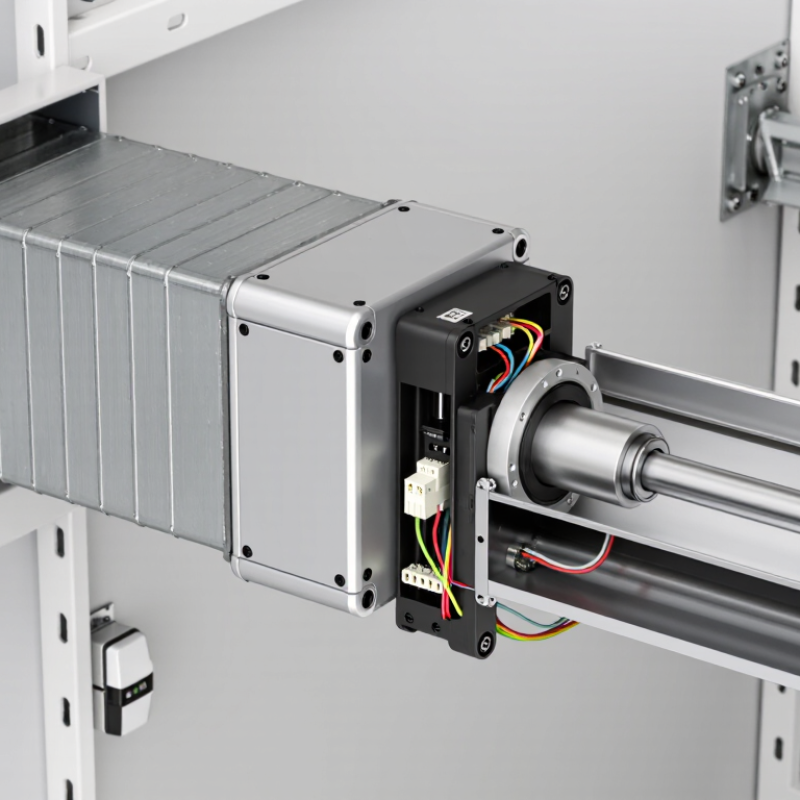
An electric damper actuator is an electromechanical device that adjusts an air damper inside a ventilation system. Its core function is simple: convert electrical commands into controlled blade movement. When a controller sends a signal, a motor turns a gear train or direct-drive mechanism. The damper then opens, closes, or holds a selected position. This regulates airflow through ducts, zones, or equipment.
In practical HVAC work, the actuator links automation logic with physical air control. A temperature sensor may detect a warm room, while the actuator opens the damper to admit more conditioned air. In smoke-control or isolation arrangements, approved designs may command rapid closure, but performance depends on the complete system. Torque, rotation angle, response time, and fail position must match the damper. A mismatch can leave blades partly closed, creating noise and unwanted pressure.
Most units use low-voltage or line-voltage power, depending on the installation. Some provide feedback, allowing a controller to verify actual position instead of trusting a command. That detail matters during commissioning. I have found that wiring checks alone are not enough; linkage alignment and free blade movement also need inspection. A small obstruction can distort results. The actuator may appear functional, yet airflow remains poor. Specifications should be checked against local codes, control diagrams, and measured operating conditions before replacement or calibration.
An electric damper actuator controls airflow by turning an HVAC damper shaft. Its main parts include an electric motor, gear train, housing, terminals, and shaft connection. Many models also use position feedback, such as a potentiometer or digital sensor. This feedback tells the controller whether the damper reached its required angle.
During operation, a control signal energizes the motor. The gears then increase torque and reduce speed. The output shaft moves the damper blade gradually. A signal may command full opening, partial airflow, or complete closure. In practical installations, wiring quality and shaft alignment strongly affect performance.
Tips: Check the actuator’s torque rating before installation. Keep the damper blade free from dirt and binding. Test movement manually before applying power. A loose linkage can imitate an electrical fault.
Field inspections often reveal simple problems behind unstable airflow. A damaged terminal, weak mounting bracket, or misaligned shaft may cause hunting. Some actuators stop using internal limits, while others rely on feedback and controller logic. Always compare the measured position with the commanded position.
Do not assume a silent motor has failed. It may be waiting for a valid signal, or its protection circuit may be active. I have found that rushed commissioning creates avoidable errors. The control diagram can look correct, yet the actuator may rotate in the wrong direction. Careful testing under real airflow conditions remains essential.
An electric damper actuator converts electrical signals into controlled damper movement. It regulates airflow in ducts, air-handling units, and smoke-control systems. Type selection affects comfort, energy use, and safety.
The most common type is the two-position actuator. It drives a damper fully open or closed, often for simple ventilation control. Modulating actuators provide gradual positioning, such as 0–10 V control, and support precise airflow adjustment. Floating-point actuators move through open, stop, and close commands. They suit systems requiring moderate control without continuous feedback. Spring-return models move to a defined safe position after power loss. Non-spring-return models usually maintain their last position, using less energy during operation. Rotary actuators fit quarter-turn dampers, while linear actuators serve dampers with straight movement.
The International Energy Agency reports that building operations use about 30% of global final energy. Its Buildings 2023 report also links buildings to roughly 26% of global energy-related emissions.
Better damper control can reduce unnecessary fan and heating demand, but savings depend on commissioning. In field checks, installers should confirm torque, rotation direction, linkage alignment, and control-signal response. A powerful actuator is not always better. Oversizing may cause hunting, noise, or premature wear. This detail is often missed.
Designers should also verify enclosure protection, fail position, cycle frequency, and temperature limits. Real installations are rarely perfect, so post-installation airflow measurements remain essential.
What Is an Electric Damper Actuator?
Applications in HVAC and Building Automation
An electric damper actuator moves an HVAC damper with a controlled motor. It regulates airflow through ducts, vents, and fresh-air openings. Unlike manual dampers, it responds to sensors, schedules, or building automation commands. A typical actuator can provide proportional control, open-close operation, or spring-return safety positioning.
This matters because airflow directly affects comfort and energy use. The 2023 Global Status Report for Buildings and Construction estimates that buildings consume about 30% of global final energy. It also links buildings to roughly 26% of energy-related emissions. In offices, hospitals, and schools, actuators help adjust outdoor air, exhaust air, and zone supply. For example, a carbon dioxide sensor can signal the actuator to increase ventilation in a crowded classroom. A temperature sensor can reduce airflow when a meeting room is empty.
Building automation systems also use actuator feedback to confirm damper position. This supports fault detection and more reliable commissioning. However, installation quality still matters. A well-designed control sequence cannot compensate for a jammed blade, incorrect wiring, or poor sensor placement. The U.S. Department of Energy identifies HVAC as a major portion of commercial building energy use, so small control errors can become expensive over time. Regular testing remains necessary, especially for smoke-control and fresh-air dampers. Automation is useful, but it is not self-correcting.
| Data Dimension | Typical Data or Specification | HVAC and Building Automation Relevance |
|---|---|---|
| Definition | An electric damper actuator is a motorized device that rotates or modulates an HVAC damper to control airflow through ducts, air-handling units, or ventilation openings. | It converts an electrical control signal into mechanical movement, allowing automated airflow regulation instead of manual damper adjustment. |
| Primary Function | Open, close, or position a damper at a selected angle, commonly from 0° to 90° depending on the damper design. | Supports ventilation control, temperature regulation, pressure control, air balancing, and smoke-control sequences. |
| Common Actuator Types | Two-position, floating-point, proportional, spring-return, and non-spring-return actuators. | The selected type depends on whether the system requires simple on/off control, modulating airflow, or automatic return to a safe position during power loss. |
| Typical Control Signals | On/off switching, three-point floating control, or proportional signals such as 0–10 V DC. | Control signals are commonly provided by thermostats, room controllers, programmable controllers, or building automation systems. |
| Common Supply Voltages | Low-voltage models commonly use 24 V AC or 24 V DC. Other models may use line-voltage supplies such as 120 V AC or 230 V AC. | The supply voltage must match the electrical design, control panel, safety requirements, and local installation standards. |
| Torque Range | Typical commercial HVAC actuators are available from approximately 2 N·m to more than 40 N·m. | Required torque depends on damper size, blade design, air pressure, sealing friction, shaft condition, and the number of blades being operated. |
| Operating Time | Many modulating actuators complete a 90° rotation in approximately 30 to 150 seconds. Two-position actuators may operate faster. | Slower movement generally provides smoother airflow and temperature control, while faster movement may be useful for isolation or changeover functions. |
| Positioning Accuracy | Proportional actuators provide continuous positioning, while two-position actuators provide fully open or fully closed operation. | Continuous positioning helps maintain stable airflow, discharge-air temperature, duct pressure, or indoor air quality setpoints. |
| Fail-Safe Operation | Spring-return actuators use stored mechanical energy to drive the damper to a predefined position when power is removed. Non-spring-return models remain in their last position unless mechanically moved. | Fail-safe positioning can protect equipment, limit smoke migration, maintain freeze protection sequences, or provide a defined ventilation response during a power interruption. |
| Typical Damper Applications | Fresh-air dampers, return-air dampers, exhaust dampers, mixing dampers, zone dampers, fan-coil dampers, and pressure-control dampers. | Actuators are used wherever airflow must be adjusted automatically in response to temperature, occupancy, pressure, or air-quality requirements. |
| Air-Handling Unit Application | Actuators modulate outdoor-air, return-air, and exhaust-air dampers in air-handling units. | They help maintain ventilation rates, mixed-air temperature, building pressure, and economizer operation. |
| Variable Air Volume Application | Zone or terminal-unit dampers are positioned to regulate the airflow supplied to individual spaces. | This supports room-by-room temperature control and can reduce fan energy when system demand decreases. |
| Demand-Controlled Ventilation | Damper position can be adjusted using occupancy information or carbon dioxide measurements. | Ventilation can be increased when spaces are occupied and reduced when demand is lower, subject to applicable ventilation requirements. |
| Building Automation Integration | Actuators may receive commands from a building automation controller and may provide auxiliary contacts or position feedback. | Integration enables scheduled operation, alarms, trend logging, remote adjustment, and coordination with fans, heating coils, and cooling coils. |
| Feedback Options | Available feedback methods include auxiliary switches, potentiometric feedback, and electronic position signals. | Feedback allows a controller to verify damper position, identify mechanical faults, and improve sequence-of-operation reliability. |
| Environmental Protection | Indoor and outdoor actuators are available with different enclosure and environmental protection levels. | Outdoor installations require suitable protection against moisture, temperature variation, corrosion, and ultraviolet exposure. |
| Energy-Saving Contribution | Accurate damper modulation can reduce unnecessary outdoor-air intake, improve economizer control, and limit simultaneous heating and cooling. | Actual savings depend on system design, control sequences, climate, occupancy, commissioning quality, and damper leakage. |
| Selection Criteria | Key factors include required torque, damper shaft size, rotation angle, control signal, supply voltage, operating time, fail-safe requirement, enclosure rating, and feedback needs. | Correct sizing prevents incomplete movement, excessive noise, premature wear, unstable control, and inadequate airflow performance. |
| Maintenance Considerations | Inspection should include damper blade movement, shaft alignment, linkage condition, wiring, mounting security, calibration, and commanded-versus-actual position. | Regular inspection helps maintain airflow performance and can reveal binding, corrosion, loose connections, or actuator overload conditions. |
| Safety Note | Smoke-control and fire-damper applications require actuators that are specifically approved and installed for the intended life-safety function. | Standard HVAC actuators should not be substituted for listed or approved life-safety equipment where building codes require dedicated fire or smoke-control products. |