Made in America
Get Connected With



Global buyers entering 2026 are choosing Custom Printed Floor mats for branding, safety, cleanliness, and customer experience. The strongest demand is moving beyond simple logo rugs. Buyers now compare performance, print clarity, material origin, backing stability, and cleaning requirements.
Top options include logo entrance mats, promotional event mats, absorbent indoor mats, outdoor scraper mats, anti-fatigue mats, and washable printed runners. Entrance mats remain practical for hotels, offices, airports, and retail stores. They capture moisture and dirt before it spreads across polished floors. Outdoor scraper mats suit harsh weather and busy doorways. Anti-fatigue mats support workers standing at counters, service desks, and production areas. Promotional mats create visible branding during exhibitions, product launches, and seasonal campaigns.
“Performance must match the installation environment, not only the visual design,” says flooring industry consultant Ryan Fasan. His point is easy to overlook. A bright print cannot compensate for curling edges, weak backing, or poor drainage. Global buyers should request abrasion testing, colorfastness information, slip-resistance data, and sample approval before placing large orders. Recycled PET surfaces may support sustainability goals, while nitrile or rubber backings can improve grip and durability. However, recycled content does not automatically guarantee long service life. That assumption deserves more careful review.
This guide examines the leading Custom Printed Floor mat types for 2026. It considers climate, traffic, branding needs, maintenance, packaging, and cross-border delivery. Some recommendations may not suit every market. That is the honest limitation. A coastal hotel, a shopping center, and a trade-show booth need different solutions. Cost matters, but replacement frequency matters too.
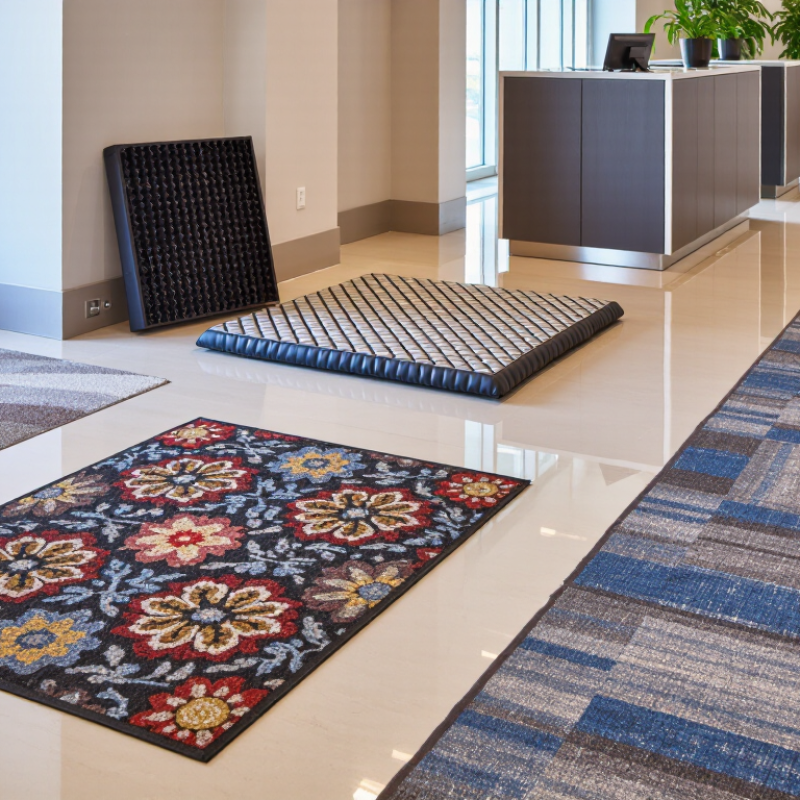
Custom printed floor mats are functional surfaces made with selected colors, graphics, text, or patterns. They protect floors while communicating a clear visual message. In my experience, a well-designed entrance mat can make a reception area feel more organized within seconds. It also captures dust and moisture before visitors walk inside. That small detail reduces cleaning pressure.
In 2026, global buyers are choosing mats for offices, hotels, shops, exhibitions, schools, and public facilities. Popular types include logo entrance mats, promotional event mats, seasonal mats, and custom-shaped mats.
Rubber-backed mats suit busy entrances because they grip the floor and resist moisture.
Textile mats provide sharper printed details and a softer walking surface.
Modular carpet tiles offer practical replacement when one section becomes damaged.
Material selection needs careful attention. A bright design may look impressive on screen but appear different under indoor lighting. Print durability can also vary with sunlight, cleaning chemicals, and daily foot traffic. I have seen buyers focus too heavily on artwork and overlook edge curling, drainage, or accurate sizing. That is a costly mistake. Measure the doorway, check the floor condition, and request a physical sample when possible. Avoid oversized mats that block doors. Safety comes first, even when appearance matters. Some choices remain imperfect, especially when buyers want vivid colors, low prices, and long service life together. Expecting all three without compromise is unrealistic.
Global buyers need different custom printed floor mat types because use conditions vary sharply. Entrance mats suit offices, hotels, and retail spaces with heavy foot traffic. They should have dense fibers, rubber backing, and strong edge binding. A 2024 Grand View Research report estimates the digital textile printing market will grow at about 19% annually through 2030. This supports wider design choices for logos, patterns, and short production runs.
For homes and exhibitions, printed polyester mats offer lighter weight and sharper color reproduction. They are easier to roll, store, and replace. However, thin versions may curl on smooth floors. That detail is often missed. Kitchen and bathroom buyers may prefer PVC or rubber mats, especially where water resistance matters. Printed surfaces need abrasion testing because attractive ink can fade near doors or under furniture.
Vehicle buyers usually need molded or cut-to-fit mats with raised borders. These designs help contain mud, sand, and spilled drinks. According to a 2024 report from Fortune Business Insights, the global carpets and rugs market was valued above 70 billion dollars in 2023, showing broad demand for floor-covering products. Yet this figure does not measure custom mats alone. Buyers should request slip resistance, colorfastness, odor testing, and cleaning instructions. Specifications are useful. Real samples are better.
Typical application-fit scores from 1 to 5, based on common material characteristics, cleaning requirements, traffic conditions and branding needs.
Key takeaway: Rubber-backed logo mats are well suited to high-traffic entrances, absorbent mats perform strongly in wet-weather areas, PVC coil mats support dirt removal and drainage, and carpet mats provide the most suitable surface for detailed promotional graphics and indoor branding.
Custom printed floor mats in 2026 will serve more than decorative purposes. They must manage dirt, moisture, foot traffic, and repeated cleaning. Material choice strongly affects these results. Nylon offers sharp color detail and good abrasion resistance. Polypropylene usually costs less and resists fading, but its texture can feel less refined. Rubber backing improves grip on smooth floors. However, poor backing quality may curl at the edges.
Printing methods also shape daily performance. Dye sublimation creates vivid designs on suitable synthetic fabrics. It works well for detailed logos and color gradients. Screen printing can produce bold blocks of color with strong surface coverage. Digital printing supports flexible artwork and short production runs. Yet printed surfaces may lose clarity when exposed to harsh chemicals or constant scraping. A mat that looks excellent in a showroom can disappoint near a busy entrance. That gap deserves honest testing.
Tips: Ask for material samples and request abrasion, colorfastness, and slip-resistance data. Test the mat with wet shoes, sand, and frequent vacuuming. Match pile height to the location. Low-pile mats suit doorways and wheeled traffic. Thicker mats may absorb more water but can obstruct doors. Check the backing under heat and humidity conditions. Small differences matter. Some buyers focus too heavily on image quality and overlook cleaning time. That is an expensive mistake. A practical specification should balance appearance, safety, service life, and local climate.
2026 Top Types Custom Printed Floor Mats for Global Buyers?
When comparing custom printed floor mats, buyers should examine material, thickness, backing, and print quality together. A vivid surface means little if the mat curls after shipment. Common options include rubber-backed fabric mats, absorbent microfiber mats, PVC mats, and outdoor scraper mats. Each type suits different entrances, climates, and cleaning routines.
Ask suppliers for exact dimensions, weight, edge finishing, and color references. Request a physical sample before approving bulk production. Samples reveal details that digital proofs often hide, including fuzzy lettering, uneven borders, or slippery backing. Check abrasion resistance, water absorption, odor, and resistance to repeated washing. Packaging also matters. Rolled mats may save space, but tight rolling can create stubborn waves. Confirm carton strength, labeling, lead time, minimum order quantity, and replacement procedures in writing. A cheaper quote is not always a lower total cost. Our early comparisons sometimes focused too much on unit price.
Tips: Compare one sample under dry and wet conditions. Place it near a doorway and test movement, edge curling, and cleaning effort. Ask for recent production photos and relevant test reports. Confirm color consistency across batches, especially for large orders. Leave realistic time for sampling and shipping. Rushed approvals create avoidable mistakes. Suppliers may also overlook small details, so buyers should check every measurement themselves.
| Custom Mat Type | Typical Construction | Common Thickness | Best-Fit Applications | Print Quality and Design Capability | Durability and Traffic Suitability | Moisture and Dirt Performance | Cleaning Requirements | Important Buyer Checks |
|---|---|---|---|---|---|---|---|---|
| Nylon Cut-Pile Printed Mat | Tufted nylon face with a rubber, PVC, or thermoplastic backing | Approximately 6–10 mm | Retail entrances, hotels, offices, banks, schools, and high-traffic commercial areas | Sharp logos, gradients, fine lines, and multi-colour artwork; suitable for high-resolution designs | Very good abrasion resistance; generally suitable for medium to heavy indoor traffic | Absorbs moisture and traps dust effectively when used as an indoor entrance mat; requires a slip-resistant backing | Regular vacuuming; periodic extraction or commercial laundering according to the backing specification | Compare face-fibre weight, tuft density, colourfastness, backing adhesion, edge binding, and dimensional stability |
| Polyester Dye-Sublimated Mat | Printed polyester textile surface with rubber or PVC backing | Approximately 3–6 mm | Promotional campaigns, exhibitions, events, reception areas, retail displays, and light-to-medium traffic | Excellent colour detail and photographic reproduction; supports complex artwork and broad colour coverage | Good for indoor promotional use; usually less abrasion-resistant than dense nylon in heavy entrance traffic | Provides moderate moisture absorption; backing quality determines slip resistance and floor protection | Frequent vacuuming and spot cleaning; avoid harsh chemicals that may affect printed colours or backing | Request colour samples, wash or rub-fastness data, print registration tolerance, and backing odour information |
| Polypropylene Loop-Pile Mat | Solution-dyed or printed polypropylene loops with a rubber or PVC backing | Approximately 5–8 mm | Budget-conscious offices, retail stores, apartment lobbies, schools, and general indoor entrances | Good for simple logos, text, and medium-detail patterns; colour range may be more limited than polyester | Good stain resistance and acceptable performance for light-to-medium traffic; loops can flatten over time | Resists many common stains and dries relatively quickly; moisture retention depends on pile density | Routine vacuuming and low-moisture cleaning; inspect loop integrity after intensive cleaning | Compare pile density, yarn denier, loop pull strength, backing flexibility, and total product weight |
| Printed PVC or Vinyl Mat | Flexible PVC or vinyl sheet with a digitally printed or embedded surface design | Approximately 1.5–3 mm | Wet-prone areas, kitchens, workshops, service counters, entrances, and temporary promotional placements | Good graphic clarity and strong colour coverage; suitable for logos, directional graphics, and warning messages | Good resistance to moisture and abrasion for its thickness; may show wear sooner in heavy wheeled traffic | Water-resistant and easy to wipe; textured surfaces can improve traction but may retain dirt in grooves | Sweep, vacuum, or damp mop with a neutral cleaner; avoid incompatible solvents and extreme heat | Check plasticizer compliance, slip-resistance test results, odour, curling tendency, fire requirements, and cold-temperature flexibility |
| Rubber-Backed Textile Logo Mat | Textile face bonded to natural or synthetic rubber backing, often with reinforced edges | Approximately 5–9 mm | Corporate reception areas, commercial entrances, corridors, hotels, restaurants, and public buildings | Good logo visibility and practical colour blocking; detail depends on the textile printing or tufting method | Good overall stability and edge protection; suitable for medium-to-heavy indoor use when properly constructed | Textile face absorbs dirt and moisture while the rubber backing helps prevent floor contact; not normally intended for standing water | Vacuum regularly; use commercial extraction only when the rubber backing is rated for wet cleaning | Verify rubber composition, backing adhesion, edge construction, floor compatibility, odour level, and slip performance |
| Recycled-PET Printed Mat | Face yarn or felt made partly or fully from recycled polyester, with rubber, PVC, or recycled backing | Approximately 3–8 mm | Sustainability-focused offices, public procurement, retail projects, events, and hospitality interiors | Good digital-print capability; recycled content can affect shade consistency if fibre preparation is not controlled | Good indoor performance when the face density and backing are suitable for the traffic level | Moderate to good moisture and soil capture; performance varies significantly with pile structure | Vacuuming and low-moisture cleaning are generally preferred; follow the exact fibre and backing instructions | Request recycled-content evidence, chain-of-custody documentation where required, colour consistency data, and end-of-life information |
| Needle-Punched Entrance Mat | Dense nonwoven fibres mechanically punched into a backing, often with a rubber border or anti-slip base | Approximately 4–8 mm | Busy entrances, warehouses, schools, transport facilities, temporary projects, and value-oriented commercial orders | Suitable for bold graphics, simple logos, and repeated patterns; fine photographic detail is usually limited | Good resistance to crushing and practical for heavy foot traffic; appearance is more utilitarian than plush mats | Effective at scraping dirt and retaining some moisture; drainage and drying depend on backing design | Frequent vacuuming, shaking, or extraction when approved by the manufacturer | Compare fibre density, surface recovery, border strength, cut-edge sealing, backing grip, and rolled-shipping deformation |
| Outdoor Scraper Mat with Printed Insert | Open-texture rubber or PVC scraper frame combined with a replaceable textile or printed insert | Approximately 8–15 mm | Building entrances, shopping centres, outdoor-covered walkways, industrial sites, and high-soil-load locations | Printed insert offers good branding space; open scraper structure is more functional than decorative | Very good scraping performance and stability when correctly installed; suited to heavy traffic and wheeled loads | Open construction allows water and grit to pass below the walking surface; requires a suitable recessed area or drainage plan | Lift and clean beneath the mat; hose or pressure-clean only when the materials and backing permit it | Check UV resistance, freeze and heat tolerance, drainage, ramped edges, trip risk, insert replacement, and total installed height |
Global buyers now request logo entrance mats, rubber-backed lobby mats, absorbent fabric mats, and outdoor scraper mats. Yet print quality is only one buying factor. A dependable supplier should explain yarn density, backing material, edge binding, dye method, and expected service life. Ask for a physical sample. Photos can hide curling edges and weak colors. Good suppliers share clear specifications, test reports, production photos, and realistic lead times.
Check whether the factory has experience with your climate and foot traffic. A snowy entrance needs strong scraping fibers and a stable, slip-resistant backing. A humid store needs quick drying and mold-resistant construction. Request a small trial order before committing to hundreds of pieces. Measure logo alignment, corner flatness, odor, absorbency, and package protection. Keep written approval records. This protects both sides when details change. Also confirm carton dimensions, shipping documents, and production capacity before placing a large order.
Reliable communication matters after payment. Suppliers should confirm artwork files, color references, carton marks, replacement terms, and inspection steps. Ask who pays when defects exceed the agreed tolerance. Vague answers are warning signs. However, buyers should review their own requirements honestly. A low price may reflect thinner backing or fewer inspections. I once underestimated storage space for bulky mats. The shipment arrived safely, but storage became a problem. That small mistake changed our purchasing checklist. Leave room for corrections. Suppliers cannot fix unclear instructions.